

Tech professionals
Senior developers, architects, Data Science and AI specialists — with patents, conference talks, or high-load projects.
O-1EB-1AEB-2 NIW
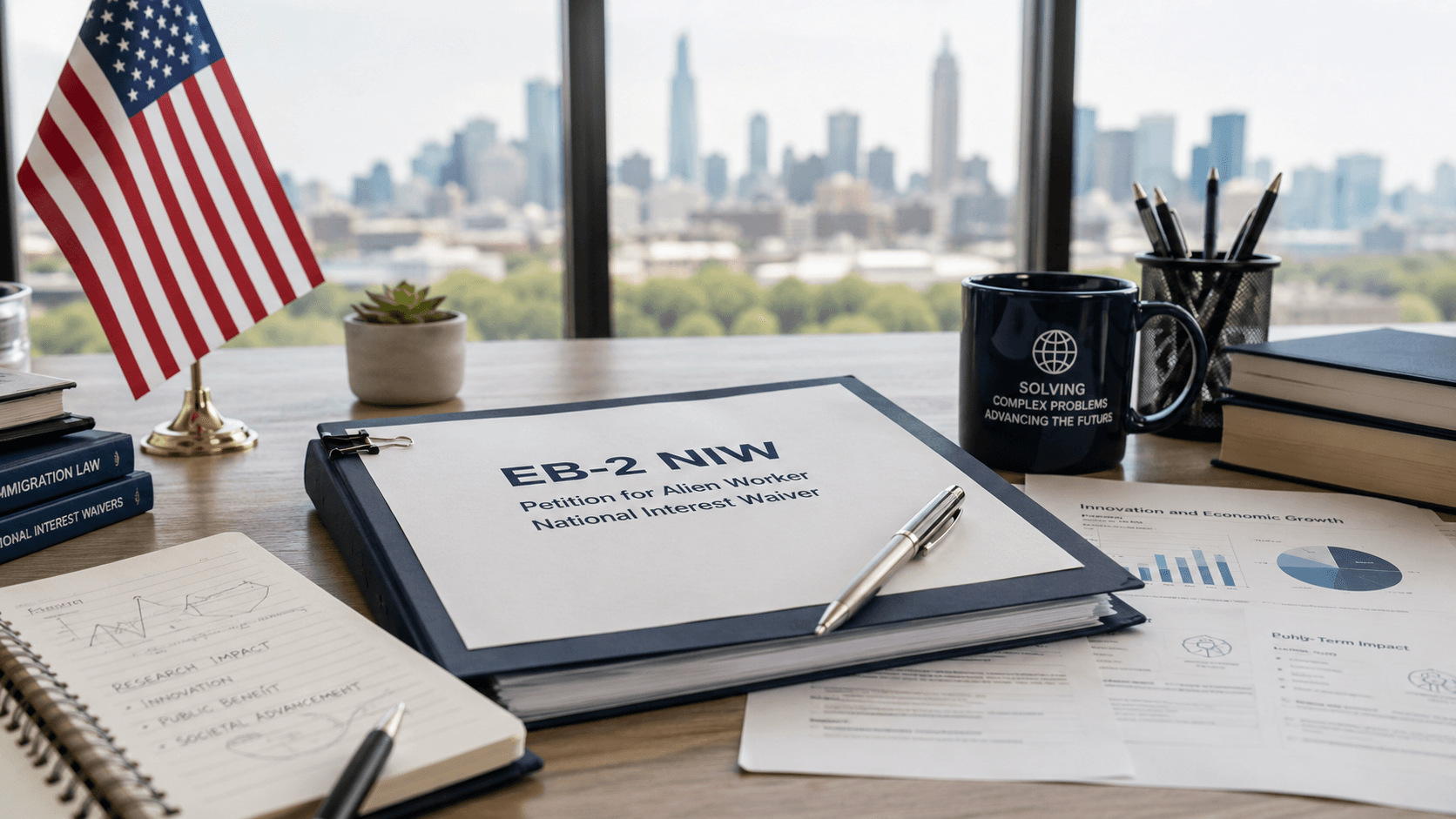
Get a Green Card through the National Interest Waiver program — no sponsor required, based on your professional achievements and the value your work brings to the US.
You file the petition yourself — no dependence on a company and no losing status when you change jobs.
Licensed US attorneys build a 200–1,500 page case file. Every argument is backed by evidence.
Approval or your money back. The terms are written into the contract, and the price is fixed — no extra charges.
We prove the value of your work to the US — no job offer and no PERM required.
EB-2 NIW (National Interest Waiver) is an immigrant category that lets you obtain a Green Card based on your qualifications and the value you bring to the US economy. The key difference — you need no employer sponsor and no Labor Certification (PERM). You file the petition on your own behalf and get a Green Card for your whole family at once: your spouse and children under 21.
Do you have a university degree and significant professional achievements? Find out which visa type is right for you.
Senior developers, architects, Data Science and AI specialists — with patents, conference talks, or high-load projects.

PhDs and researchers with publications, grants, and citations in peer-reviewed journals.

Tech entrepreneurs, business owners, and startup founders ready to launch or scale a company in the US market.

Leaders of international companies — a transfer to a US office or a Green Card through EB-1C.

From $800K in EB-5 or $100K in E-2 — a Green Card and status for your whole family.

Painters, musicians, film directors, and designers with exhibitions, festivals, and awards.

Surgeons, physicians, and clinical researchers with publications and professional recognition.

Professors, lecturers, and experts with academic work and international recognition.

Athletes and coaches with podium finishes, rankings, and national team experience.

Influencers, journalists, and media personalities with an audience, reach, and publications.
Don't see your profession here? We work with professionals from many different fields.
Check if I qualifyThe baseline EB-2 requirement: a master's degree or its equivalent (a bachelor's plus 5 years of progressive experience in your field). Non-US degrees are assessed through a credential evaluation.
If you don't have a master's, you can prove exceptional ability instead: 3 of the 6 USCIS criteria (a degree, 10+ years of experience, a license, a high salary, membership in associations, recognition in your industry).
Your work benefits the US economy, science, technology, education, or healthcare. Significance within your specific field is enough — it does not have to be national in scale.
Education (master's+), experience, publications, patents, letters of recommendation, a history of success. A track record showing that you are the person who will deliver this value.
The attorney argues why tying you to an employer and a Labor Certification would limit the value you bring to the country. This is a legal argument written individually for each case.
Peer-reviewed publications, patents, awards, a high salary, letters of recommendation from independent experts, citations, membership in associations, grants, speaking engagements.
An attorney will review your profile against the three Dhanasar prongs — for free. You will learn what is already strong, what needs strengthening, and how long preparation will take.
You fill out a questionnaire, and our specialists analyze your case in detail to assess your real chances of approval. At this stage you already see which path is the most promising for you. We then contact you to schedule an online meeting that suits you.
Take the first step — get a free expert consultation and an eligibility checklist
Consultation| Stage | Timeframe |
|---|---|
| Profile assessment and contract | 1–2 days |
| Building the evidence portfolio | 2–4 months |
| Preparing the I-140 petition | 1–2 months |
| USCIS processing | 12–18 months / 45 days (Premium) |
| AOS or consular processing | 1–12 months |
The longest stage is building the evidence portfolio. The pace depends on how quickly you provide publications, letters of recommendation, and proof of income. Premium Processing for the I-140 cuts the USCIS part to 45 days.
At Migrator, every case goes through three rounds of document review by specialists at different levels — the final word and the filing always belong to a licensed US attorney.
Every EB-2 NIW case is handled by a licensed US attorney. The company takes on the financial risk — it is written into the contract.
* The 95% approval rate is an approximate figure based on approved cases across different time periods and visa categories.

Every case is handled by a licensed US attorney or accredited representative specializing in immigration law. Hundreds of approved EB-2 NIW petitions.

Approval or a full refund — the terms are written into the contract. Migrator takes on the financial risk — this is not a marketing gimmick.

The price is set before the contract is signed. RFE responses, additional consultations, case adjustments — all included. Government fees are not included.

In your personal chat: department head, supervisor, paralegal, case manager, and an AI bot. Weekly progress updates.

The coordinator checks completeness, the attorney checks legal strength, the senior partner checks case strategy. Your petition passes three filters before it reaches USCIS.

We help with AOS, consular processing, and settling in: choosing a state, banking, taxes, housing. We stay in touch after you get your Green Card.

US immigration policy is changing. The Dhanasar standards that pass today may be read more strictly a year from now. Cases approved in 2024 already require a stronger evidence portfolio in 2026.
Standard I-140 processing keeps getting longer. What used to take 8 months can now take 12–18. The sooner you file, the sooner you get a result — and your Green Card.
A 2022 publication carries more weight than the same publication in 2028. Citations take years to accumulate. The fresher and more active your track record, the stronger your prong 2 case.
Children adapt more easily at 5 than at 12. It is easier for a spouse to start a career at 35 than at 45. Every year of waiting is a year your family could have spent in the US with a Green Card.
Fill out the form — an immigration specialist will contact you with a free assessment of your case.
Not sure you’d qualify? See real client cases — with USCIS approval letters.
View case studiesYes. Form I-140 may be filed from outside the United States. After approval, consular processing generally follows once an immigrant visa is available.
No. It approves the immigrant classification, not the Green Card itself. The applicant still needs an available immigrant-visa number and must complete consular processing or Adjustment of Status.
NIW is not based on a specific employer, but the applicant should maintain the intention to advance the proposed endeavor described in the petition. A material change in the project may require a separate strategic assessment.
Not always. A person may also establish the underlying EB-2 qualification as an individual of exceptional ability, but the criteria and supporting evidence must be evaluated separately.
No. Neither is automatically required. Evidence should fit the profession and may include project results, independent evaluations, documented impact, contracts, market data, and other relevant materials.
The priority date determines the case’s place in the immigrant-visa queue. It is compared with the monthly Visa Bulletin for the category and the applicant’s country of chargeability.
Premium Processing speeds up the available USCIS action on Form I-140, but it does not eliminate a visa backlog or accelerate the later immigrant-visa or Adjustment of Status process. The choice depends on the objective and whether the evidence is ready.
Address every RFE point and show the connection between your qualifications, the proposed endeavor, and its benefit to the United States. General recommendation letters without verifiable facts are usually weaker than specific, documented evidence.